Ankit Sarkhel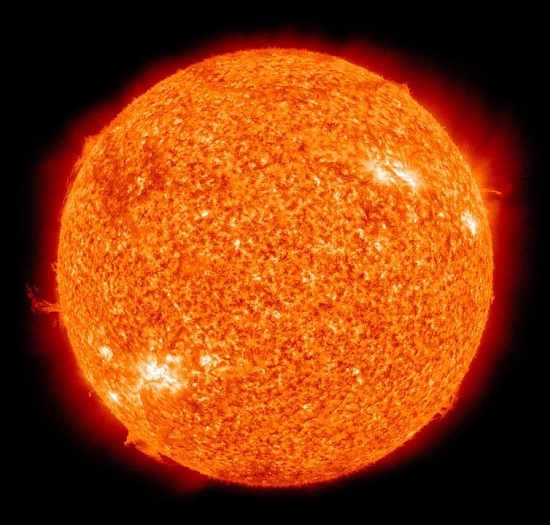
A star is a very bright astronomical ball of gas made up of mainly hydrogen and helium, held together by its gravity.
Nuclear hydrogen fusion reaction in its core supports the star against its own gravity and in doing so generates light and heat energy, as well as some small amount of heavier elements.
Star Approaching the End of its Lifespan
A star that is nearing its end uses up most of its fuel and becomes small and lighter than its initial state.
When the star becomes small the matter particles get very near each other, but according to Pauli’s exclusion principle proposed by Wolfgang Pauli in 1925, two particles can never have the same position and same velocity at the same time.
This means that two particles can never occupy the same Space-Time coordinate with their velocities being the same.
In order to not violate the exclusion principle, the closely packed particles in the star acquire different velocities.
This makes the matter particles move away from each other and so it tends to make the star expand.
So, the star maintains itself at a constant radius by a balance between the attraction of its gravity and the repulsion arising from Pauli’s exclusion principle.
But there is a limit to the repulsion that the exclusion principle can provide.
The special theory of relativity limits the maximum difference in the velocities of the matter particles to the speed of light (i.e., no particle can move faster than a photon).
This means that if the star got dense enough, the exclusion principle repulsion would be less than the gravitational attraction.
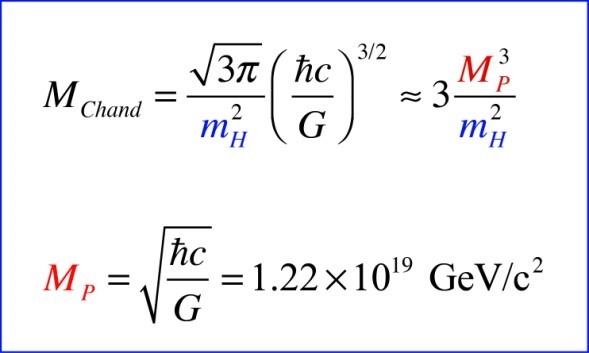
A cold star of mass more than about 1.39 times the solar mass would not be able to support itself against its own gravity.
This mass limit is known as the Chandrasekhar Limit first proposed and calculated by the world Famous Astrophysicist and Noble laureate himself- Dr. Subrahmanyan Chandrasekhar, and its precise value is 2.765 * 1030Kg.
For stars of mass less than the Chandrasekhar Limit:
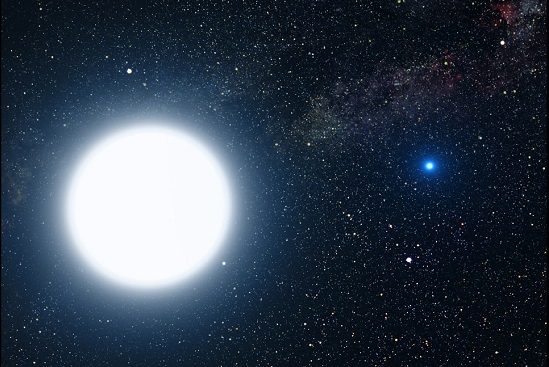
- If a star’s mass is less than the C. Limit it can stop contracting and eventually settle down to its final state as a White Dwarf, with a radius of a few thousand miles and a density of hundreds of tons per cubic inch.
A white dwarf is supported by the exclusion principle of repulsion between the electrons in its matter.
- There is also another possible final state for a star of mass within the C. Limit but it would be much smaller than a white dwarf.
Astronomers Walter Baade and Fritz Zwicky in 1934 proposed that these stars would be supported by the exclusion principle of repulsion between their neutrons and protons rather than electrons.
They were therefore named Neutron Stars. They would have a radius of only ten miles or so but a density of hundreds of millions of tons per cubic inch.
Related | White Dwarf Star Facts & Information
For Stars of Mass More than the Chandrasekhar Limit
Now, stars with masses above the C. Limit have a big problem during their last phase. There are two possible scenarios from this point onward;
- 1st possibility is that they might explode or manage to throw off enough matter to reduce their mass below the C.
Limit and transform into a white dwarf or a neutron star and in doing so avoid catastrophic gravitational collapse.
This explosion is called a Supernova Explosion.
- 2nd possibility is that if a star’s mass is more than 8-20 times the solar mass, it will collapse on its own gravity forming a singularity in Space-Time with almost infinite density, otherwise known as a Black Hole.
The singularity lies at the center of the black hole, so its size and the magnitude of its gravitational energy are determined by its boundary, otherwise known as the event horizon.
An event horizon is the region of the black hole beyond which nothing can escape, not even light.
So, if a photon travels beyond the reaches of the event horizon it gets trapped in the black hole forever.
Conclusion
The death of a star is more eventful than politicians screaming their lungs out while either promoting his/her achievements as a leader or demoting politicians of other parties.
Climate change will give them nightmares in a few decades if this goes on. It’s a joke by the way. Take the Astrophysical information seriously not this.