Bottom Science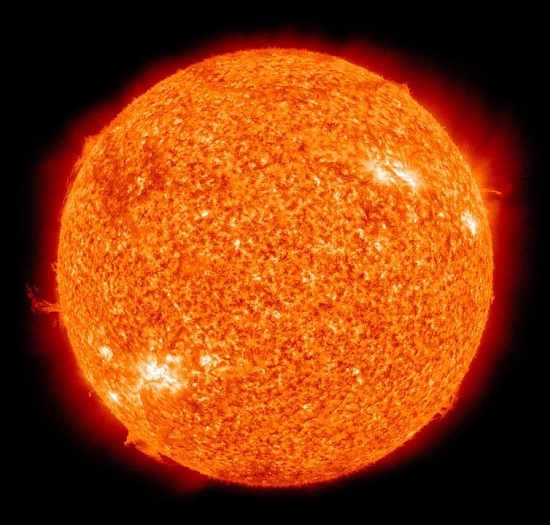
Physicists at the University of Wisconsin-Madison built a spinning ball of plasma; they call it the Big Red Ball (BRB). They built it to study the working of stars deeply. It could also help us to understand some fundamental solar processes.
Like most main-sequence stars, the sun is a huge ball of hydrogen massive enough to bear a nuclear fusion reaction. The hydrogen fuses into helium, and helium eventually fuses into heavier elements as stars exhaust their fuel.
As we know, our sun is near to us and easy to spot in the sky. So, scientists have spent a great deal of time studying our life-giving stars.
About Experiment
The experiment consists of a 3-meter-wide aluminum vacuum chamber, which they dubbed “the Big Red Ball,” to re-create some of the solar physics that take place in and around the sun.
The BRB uses helium to create similar conditions to those on the sun but without all that troublesome nuclear fusion. Experiments have shown – it’s extremely difficult to maintain nuclear fusion on Earth. The team filled the vacuum chamber with helium gas (a major component of the sun) and ionized it with microwave heating to form sun-like plasma. Powerful magnets restrict the plasma, and an electrical current causes the miniature sun to spin a bit like the real one.
“Satellite missions have documented pretty well where the fast wind comes from,” said Ethan Peterson, lead author of the study and a graduate student at UW-Madison. “We were trying to study specifically how the slow solar wind is generated and how it evolves as it travels toward Earth,” he added.
The sun and its atmosphere are made up of plasma, a mix of positively and negatively charged particles at extremely high temperatures. The solar wind carries this plasma in a stream away from the sun and out onto space.
Benefits of the Experiment
The mini-sun could help scientists gain a better understanding of some of the Sun’s more mysterious behavior. Earth-based experiments like the BRB can help scientists better understand the data collected by solar missions like the Parker probe. By recreating sun-like conditions in the lab like this, we can begin to know some of the sun’s mysteries. For example, no one knows what causes the solar wind to accelerate away from the sun. The solar wind can affect satellites and ground systems here on Earth, and it may one day be a feasible way of traveling around the solar system with solar glides.
In addition, the researchers also identified plasma “burps,” which are huge ejections of plasma that stream out of the sun and sometimes fuel the solar wind. With probes inside the BRB monitoring the work, the team could see how they moved and how fast the plasma was spinning.
“These ejections are observed by satellites, but no one knows what drives them,” Peterson said. “We ended up seeing very similar burps in our experiment, and identified how they develop.”