Bottom Science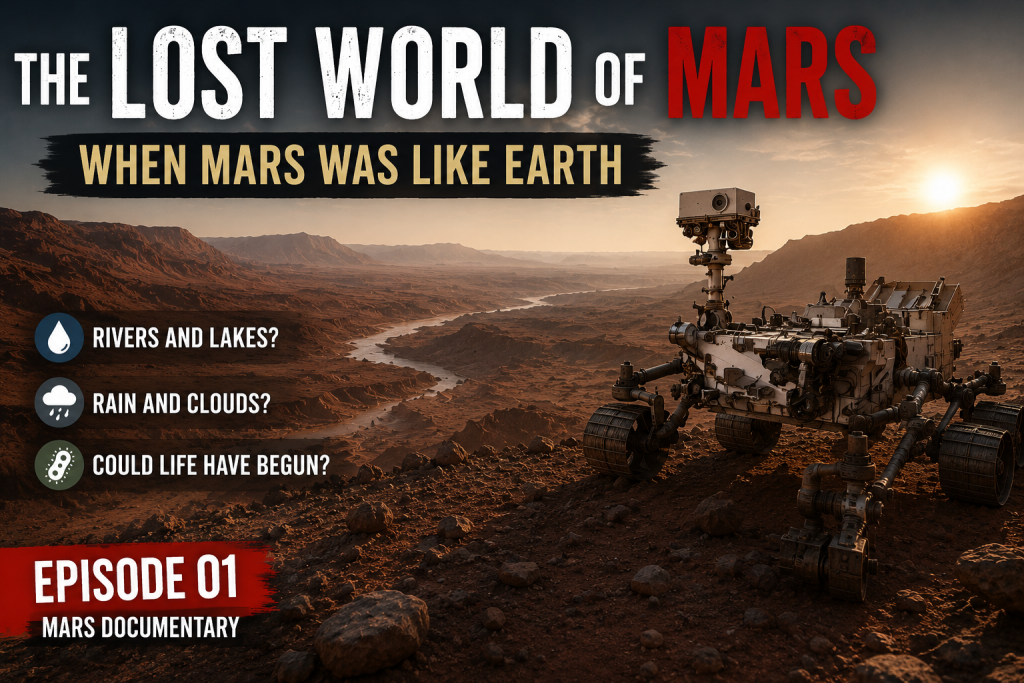
Video Explanation
The Lost World of Mars: When Mars Was Like Earth
When we think about Mars today, we imagine a cold, dry, and dusty world. Its red surface is covered with rocks, giant volcanoes, and endless deserts. There are no rivers, no forests, and no oceans. At first glance, Mars looks like a planet where nothing could ever survive.
But what if that wasn’t always true?
Scientists now believe that billions of years ago, Mars was a very different place. Instead of being a lifeless desert, it may have had flowing rivers, beautiful lakes, and even a large ocean. Some researchers even think that early Mars could have supported simple forms of life.
This idea completely changes the way we think about the Red Planet.
Mars Wasn’t Always Red and Dry
Mars formed about 4.5 billion years ago, around the same time as Earth. During its early history, the planet was much warmer than it is today. It also had a thicker atmosphere, which helped keep the surface warm enough for liquid water.
Water is one of the most important ingredients for life as we know it. Wherever scientists find evidence of water, they become excited because it increases the possibility that life may once have existed there.
For many years, people believed Mars had always been a frozen desert. However, modern space missions have completely changed that idea.
The Evidence Hidden on Mars
Orbiters and rovers exploring Mars have discovered something amazing.
Across the planet, scientists have found ancient river valleys that look very similar to rivers on Earth. These valleys are not random cracks in the ground. They twist and turn naturally, showing that water once flowed across the surface for a very long time.
Researchers have also discovered dried-up lake beds and fan-shaped landforms called deltas. On Earth, deltas are created when rivers flow into lakes or oceans and leave behind sand and small rocks. Finding similar features on Mars tells us that water was once present there.
Another important discovery is special minerals that can only form when rocks stay in contact with water for long periods.
These discoveries tell the same story again and again.
Long ago, Mars had water.
Did Mars Have an Ocean?
One of the biggest questions in planetary science is whether Mars once had an ocean.
Many scientists believe that a huge ocean may have covered much of the planet’s northern hemisphere billions of years ago. If this idea is correct, Mars may have had beaches, shorelines, and waves just like Earth.
Although scientists are still studying this possibility, more evidence continues to support the idea that ancient Mars was much wetter than the planet we see today.
Imagine standing on the shore of an ancient Martian ocean while rivers flowed into it from distant mountains.
It sounds like science fiction, but it may have been real.
Could Life Have Existed on Mars?
Whenever people hear the words “life on Mars,” many immediately think about intelligent aliens or flying spaceships.
But that is not what scientists are looking for.
Instead, they are searching for tiny microorganisms called microbes.
On Earth, microbes can survive in some of the most extreme places imaginable. They live deep underground, inside rocks, near volcanic vents, and even in freezing environments.
If tiny organisms can survive under such difficult conditions on Earth, it is possible that similar life could have existed on ancient Mars when water was flowing across its surface.
So far, no mission has found direct proof that life ever existed there.
However, scientists continue searching because the possibility is simply too important to ignore.
Even discovering ancient microscopic life would completely change our understanding of the universe.
Why Scientists Keep Exploring Mars
Mars is one of the most explored planets in our Solar System.
Several robotic missions have helped us understand its history. Orbiters study the planet from space, while rovers carefully examine rocks and soil on the surface.
Every new mission answers some questions but also creates new ones.
Where did all the water go?
Did Mars really have an ocean?
Did life ever begin there?
These mysteries are the reason scientists continue exploring the Red Planet.
Each discovery brings us one step closer to understanding what happened billions of years ago.
Mars and Earth: Two Different Futures
Mars and Earth were both born around the same time, but today they are completely different worlds.
Earth is full of life, oceans, forests, and a thick atmosphere that protects everything living on its surface.
Mars, on the other hand, is cold, dry, and almost airless.
Studying Mars is not just about learning the history of another planet. It also helps scientists understand Earth’s past and future.
By learning why Mars changed so dramatically, we may discover more about how planets evolve and what makes them suitable for life.
The Story Is Just Beginning
The story of Mars is one of the greatest mysteries in space exploration.
The evidence strongly suggests that the Red Planet was once a much warmer and wetter world than it is today. Rivers carved valleys, lakes filled giant basins, and perhaps even an ocean covered part of its surface.
Whether life ever existed there remains one of the biggest unanswered questions in science.
As new missions continue exploring Mars, we may be closer than ever to finding the answer.
In the next episode of this documentary series, we will explore an even greater mystery.
If Mars once had rivers, lakes, and maybe even an ocean, what happened?
How did an entire planet lose so much of what made it habitable?
The answer reveals one of the most fascinating stories in the history of our Solar System.